

I solve problems people don't know they have.
You may already know where difficulties are showing up: a recurring conflict, a stuck decision, a relationship under strain, a project that is not moving, or something that keeps happening despite your efforts to change it.
What might be less obvious is what is organising it: the factors that are shaping the problem.
That’s because sometimes the presenting problem isn’t the problem you need to solve — it’s the data that can help you understand the underlying pattern.
That’s what I work with.
It might be a symptom of something deeper, part of a wider pattern, a response that no longer fits the situation, or even something useful appearing in an unhelpful form.
That is why I do not start with solutions. Solving the wrong problem can be worse than not solving it at all.
I start by working out what is shaping the situation, what kind of problem it is, and where attention is most likely to make a difference, so that what happens next fits the purpose, problem and context.
Not every problem is the same kind of puzzle.
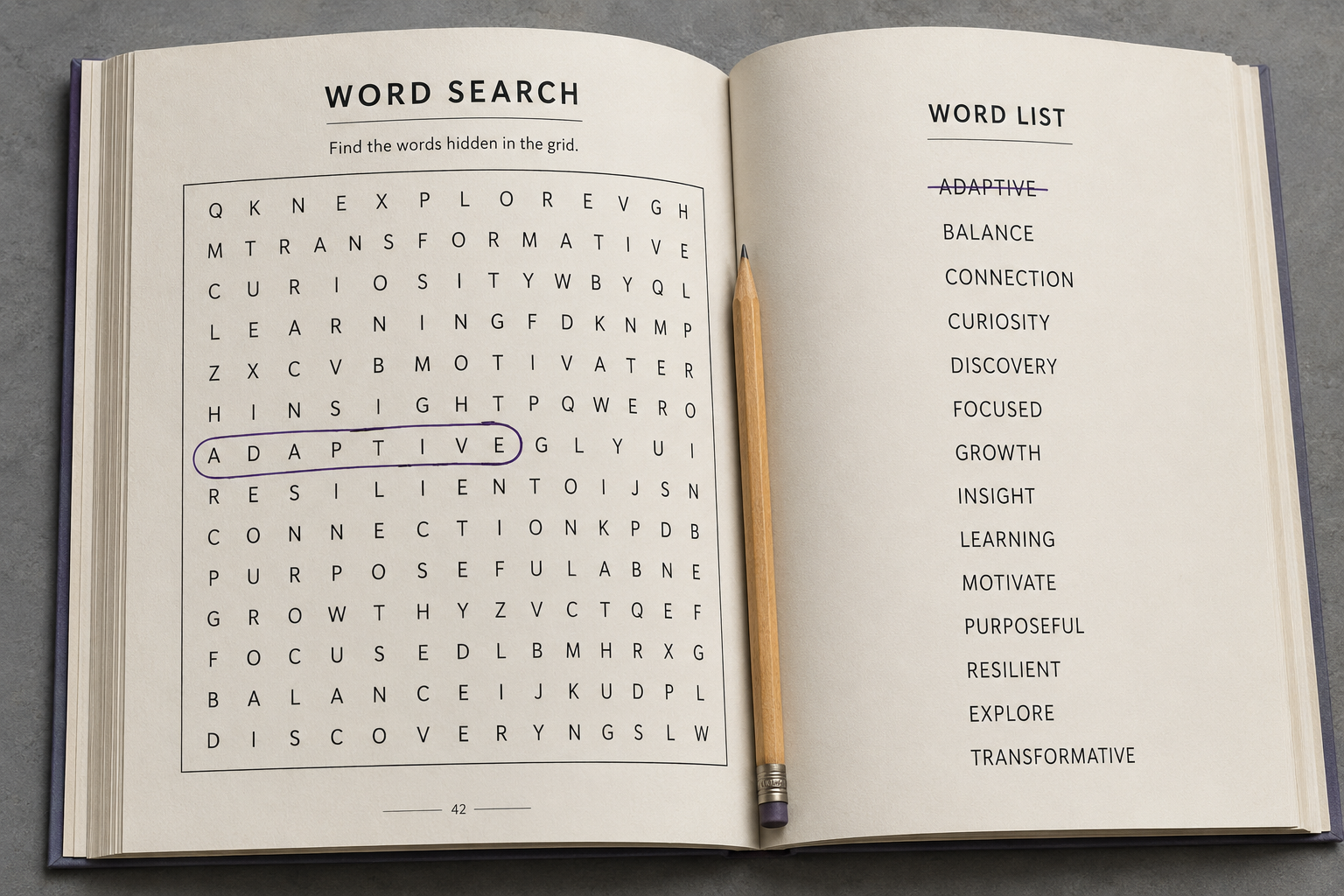
Some problems are a bit like wordsearches: once you know what you're looking for, finding it is relatively straightforward.
Others are more like cryptic crosswords. The obvious reading isn't necessarily the useful one.
And some are pattern puzzles. You need to understand the relationships between what's already there — and what isn’t — before you can work out what might fit.
Sometimes, what looks like one kind of puzzle turns out to be another.
The trick is working out what kind of puzzle you're dealing with before deciding how to solve it.
In my practice, that means paying attention to three things.
And I start by reading situations.
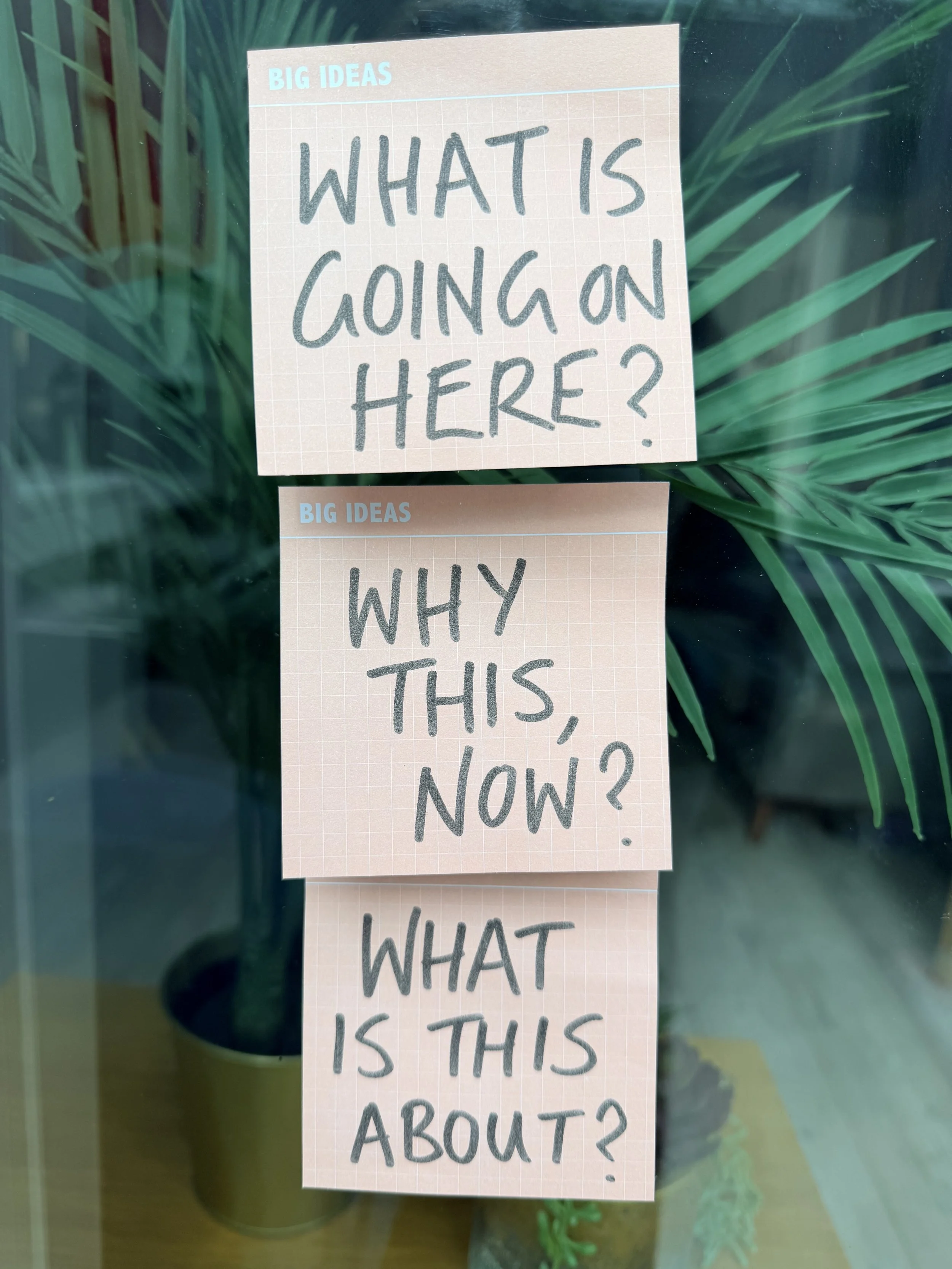
I want to understand what is happening. I also want to explore what is organising what is happening — I do that by exploring what the situation is about. Because things that look similar can have very different purposes.
A behaviour can look the same whilst serving a different function. A recurring problem can have different things organising it. Two teams can appear to be struggling with the same issue but need very different responses.
And when we’re in the middle of a situation, its visible shape is often the easiest thing to see. What it means, what is producing it, and what matters about the context can be much harder to distinguish.
So I pay attention to both similarity and difference: what looks familiar, what doesn’t quite fit, what changes with context, and what might be having more impact than it first appears.
Because recognising the shape of a problem can tell us where to start.
Understanding what that shape is doing helps us work out what might actually help.
Sometimes that’s an episode of focused inquiry that understands and unlocks a single stuck moment. Sometimes it's working alongside someone or a team for longer, so the pattern — not just the instance — has time to be seen, understood, and worked with. Other times it's delivering a talk or a session that helps an audience reframe something familiar, see additional dimensions of a situation, and encounter practical possibilities arising from a different perspective.
All approaches share a common goal: to help people and organisations develop a greater sense of what is happening, understand what is shaping it, and identify responses that fit — so they can respond with greater clarity, discernment, and alignment.
Doing this once is adapting;
Doing it repeatedly is adaptive;
Doing this to guide your life, team or organisation is Adaptive Navigation.
I designed the Adaptive Navigation System to make this repeatable — not just a method for solving one problem, but a way of reading situations so the right response becomes easier to find.
I work with people, context, and people in context.
Here’s where that starts.
Which of these best describes how you prefer to access information?
-
The About page is the story of NH Adaptive and a little bit about the Adaptive Navigation System.
-
The Services page is for you. It contains high level details of the different things NH Adaptive offers.
There are links to the detailed pages if you do want to read more.
If you’d prefer to talk things through then you can also a book a call.
-
Looking at the options in the dropdown on the right can help guide you to the page that fit’s best in relation to what you’re looking for.
You can also use the Services pages if you’d like an overview and links to each of the pages individually.
-
Downloadable versions are below:
Which of these best describes what has brought you here?
-
You may be facing a consequential decision, transition, relationship or just feeling ‘not-quite-right’ or that things could be better but you’re not sure why or where to start.
Explore Individual Adaptive Partnership -
You may be noticing recurring tensions, misalignments, or unintended outcomes and impacts and would like support to understand what’s going on and how to find a response that fits.
Or perhaps you’re seeking to understand, preserve and build on what is already working particularly well and would like support to capture and codify why, so you can continue making progress.
Explore Team Adaptive Partnerships & Organisational Adaptive Partnerships
-
You may be looking for a keynote or applied session that reframes something familiar, expands how people understand it and creates useful possibilities for what comes next.
Explore Adaptive Perspectives
-
You may not know exactly what needs to be ‘fixed’, you may be wondering whether an Adaptive Partnership is the right next step. Discovery is part of the Adaptive Perspective family, which provides a bounded inquiry with value in its own right.
Explore Adaptive Perspectives: Discovery
-
You may want to know how the thinking behind this approach works, not just what it produces — or you’re curious about the person who built it before you decide whether any of this is for you.
About the Adaptive Navigation System or the full range of Services